
Better Odds.
Lower Commission.
No House Edge.
Matchbook is a peer-to-peer betting exchange where punters set the prices and bet against each other, not against a bookie. Just 2% commission on net winnings, margin-free Matchbook Zero markets and deep liquidity on racing and football.
18+ only. Offers apply to new customers in eligible countries only. T&Cs apply. gamblinghelponline.org.au
How the Exchange Works
Margin-Free Markets
ZEROPick a market on racing, football or other sports
Back a selection to win or lay it to lose
Take the best price or set your own odds
Pay 2% commission only on a winning market
Regulation
UKGC Licensed
Commission
2% Net Win
Established
Since 2004
Apps
iOS & Android
Operator
Triplebet Ltd
Matchbook AU is a betting exchange, a platform where punters bet against each other instead of against a bookmaker. One person backs an outcome to happen, another lays it to fail, and the exchange matches the two sides and settles the bet once the result is in. Because there is no bookie setting a margin on every price, the odds tend to sit closer to the true chance of an outcome, and the platform earns its money through a small commission on net winnings.
The exchange has been running since 2004 and built its name on horse racing and football, with a reputation among serious bettors for low costs and strong liquidity on major markets. Over the years it has added a Bet Builder, multiples, a casino and the Matchbook Zero product, so it now covers more than pure exchange trading.
At its core, Matchbook is a marketplace for bets. The platform does not take a position on any event. It lists the odds that users are offering and asking for, holds the money of both sides while the event runs, and pays out once the result is confirmed. Match book does not care who wins, because its income comes from commission, not from punters losing.
So what is a Matchbook bet, exactly? If you think a horse will win, you back it at the odds on offer. If someone else thinks it will lose, they lay it, taking on the role a bookmaker would normally play. When the two bets meet at the same price, they are matched, and one side wins the other’s stake once the race is run. Match book then takes its commission from the winner’s net profit on that market.
| Feature | Details |
|---|---|
| Type | Betting exchange with sportsbook-style extras |
| Founded | 2004 |
| Operator | Triplebet Ltd, Guernsey |
| Standard commission | 2% on net winnings |
| Main sports | Horse racing, football, tennis and more |
| Extra products | Matchbook Zero, Bet Builder, casino |
| Apps | iOS and Android |
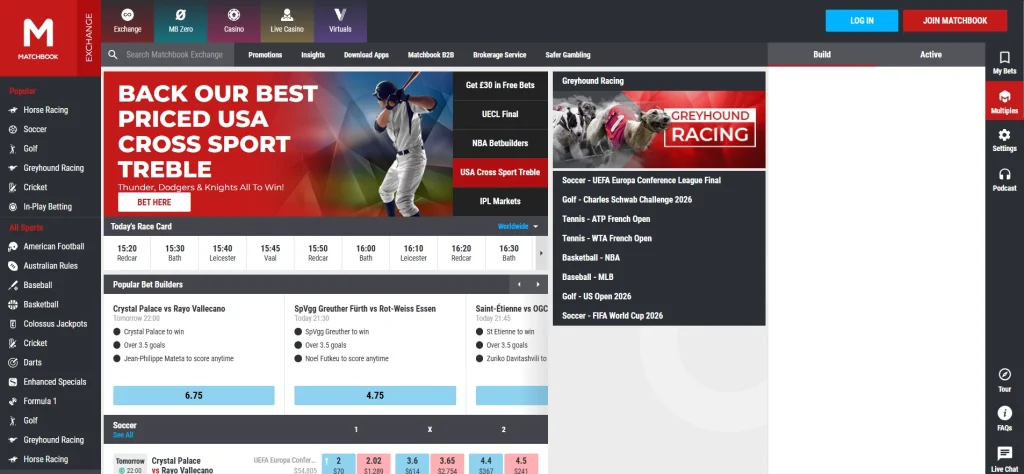
Odds are shown in decimal format, the same way most Australian punters already see them, and every price comes with the amount of money available at it. That second number is what makes an exchange different to read. A price of 3.5 with thousands waiting behind it is a solid market, while the same price with a few pounds is a thin one that may move as soon as someone bets.
The model rewards punters who shop for value and are happy to set their own prices. It also suits people who want to bet against an outcome, something a traditional bookmaker does not allow. Casual punters can still use it like a normal betting site by simply taking the best back price on offer.
Who Runs Matchbook Australia
Matchbook.com is operated by Triplebet Ltd, a company registered in Guernsey that has owned the exchange since 2011. The brand itself dates back to 2004, which makes it one of the longest-running betting exchanges still trading. It holds a licence from the UK Gambling Commission under number 39504 and is also licensed by the Alderney Gambling Control Commission, so its main customer base sits in the UK and Ireland.
There is a strong Australian thread in the ownership. The majority owner is Zeljko Ranogajec, the Australian-born professional gambler who made his name with computer-assisted betting on racing and lotteries, and who is widely regarded as one of the biggest punters in the world. His background goes some way to explaining Matchbook’s focus: low commission, sharp prices and a platform built for people who bet in volume.
Day to day, the business runs as a mid-sized exchange that competes on price rather than marketing spend, with most of its liquidity concentrated on UK racing and top-flight football.
Recent Changes: Betdaq and Prediction Markets
The past year has been busy. In October 2026, Matchbook AU bought the Betdaq brand and domains, bringing together two of the oldest names in exchange betting. The aim is a single, larger pool of liquidity, which matters on an exchange because more money in the market means tighter prices and quicker matching.
Matchbook has also moved into prediction markets. It began rolling them out in the UK in 2026, with contracts priced as a percentage chance of an outcome rather than traditional odds. A US version is in the works through a partner that has filed paperwork with American regulators. For punters, the core exchange stays the same, but the platform is clearly positioning itself for a wider audience.
How Matchbook Betting Works
Matchbook betting follows the same logic on every market, whether it is a Saturday race at Ascot or a Premier League match. Each price on the screen is an offer from another user, and the amount next to it shows how much money is waiting at that price. Back prices sit on one side of the market and lay prices on the other, with the best of each closest to the middle.
Placing a bet takes a few steps:
- Open the event and choose the market, such as the race winner or the full-time result.
- Decide whether to back the selection to win or lay it to lose.
- Take the best price on offer, or type in your own odds and wait for someone to accept them.
- Enter your stake and confirm. The bet is matched in full, matched in part or left in the queue.
- Once the event is settled, winnings land in your balance, minus commission on your net profit for that market.
The key choice is in step three. Taking the price on offer gets you matched straight away, much like a bookmaker bet. Asking for a better price means waiting, and your offer only goes through if another user agrees to it before the event starts or the odds move away. Experienced punters often post their own prices hours before a race and let the market come to them.
Unmatched bets can be cancelled or edited at any time before they are taken, which gives you more control than a fixed-odds bet slip. Once a bet is matched, it cannot be cancelled, but it can be traded out. You place an opposite bet on the same selection to lock in a profit or cut a loss before the result is known.
Back and Lay Bets on Match Book Markets
Every market on the exchange works like a match book: a running ledger of back and lay offers waiting for someone on the other side. Backing is the familiar part. You stake £10 at odds of 4.0, and if the selection wins you collect £30 profit plus your stake.
Laying turns you into the bookmaker. If you lay that same selection at 4.0 for a £10 stake, you win the backer’s £10 if it loses. If it wins, you pay out £30, which is your liability. Matchbook Australia shows the liability before you confirm, so you always know the most you can lose on a lay.
Combining the two opens up trading. You can back early at a bigger price and lay later at a shorter one, locking in a profit whatever the result.
Odds, Liquidity and Matched Bets
Liquidity is the amount of money available to bet at each price, and it decides how quickly your bet is matched. On major UK races and big football matches, there is usually plenty of money at the best prices, so bets match almost instantly. On smaller leagues or niche markets, the gap between back and lay prices widens and less money sits in the queue.
If only part of your stake is matched, the rest waits at your price until another user takes it or you cancel it. The Betdaq deal should help here, as a bigger shared pool means deeper markets across more events.
Commission and Matchbook Zero
Commission is the main cost of using Matchbook. The standard rate is 2% of your net winnings on each market, and it is only charged when you finish a market in profit. Win £100 on a race and you pay £2; lose, and there is nothing to pay. That flat, low rate is the main reason volume bettors use the exchange.
Because commission is charged per market rather than per bet, everything you do on one market is netted together first. Say you back two horses in the same race, winning £60 on one and losing £20 on the other. Your net profit on the race is £40, and the 2% is taken from that, not from the £60. This matters most for traders who move in and out of a position several times before the off, as only the final result counts.
Matchbook Zero takes the idea a step further. On selected horse racing and football markets, the platform offers prices with no built-in margin and charges no commission on winnings. In practice, you get odds that reflect the fair chance of each outcome, with nothing taken off the top. The range of markets is narrower than the full exchange, so it works best for punters who stick to the main racing cards and top football leagues.
| Product | How prices are set | What you pay |
|---|---|---|
| Exchange (back and lay) | Offered by other users | 2% of net winnings per market |
| Matchbook Zero | Fair odds with no margin | No commission |
| Bet Builder and multiples | Set by Matchbook, sportsbook style | Margin built into the price |
To put the numbers in context, a typical bookmaker price on a coin-flip football market might be around 1.90 on both sides. On the exchange, the same market often trades close to 2.0, and after 2% commission a winning bet still returns about 1.98. Over hundreds of bets, that gap adds up to a meaningful amount.
Matchbook Sports and Markets
Horse racing and football are the backbone of Matchbook sports, and that is where you will find the deepest markets and the tightest prices. Racing covers the full UK and Irish cards every day, along with major international meetings. Football runs from the Premier League and Champions League down through the main European leagues.
Each sport comes with its own set of markets. On racing, the main ones are the win market and a separate place market, so you can back or lay a horse to finish in the places as well as to win. Football offers far more choice: match odds, over and under goals, correct score, both teams to score, half-time results and Asian handicaps on the bigger games.
Beyond those two, the exchange lists a solid spread of other sports:
- tennis, covering the Grand Slams and the main ATP and WTA tours
- cricket, with Test, one-day and T20 matches
- golf, focused on the majors and big tour events
- basketball and American football, mainly the NBA and NFL
- rugby union and rugby league
- darts, snooker, boxing and MMA
Liquidity drops off outside the headline events, so lower leagues and smaller tournaments can carry wider gaps between back and lay prices. On a Tuesday night in a second-tier league, the best back and lay prices might be several ticks apart, with only small amounts waiting at each.
For the biggest fixtures, in-play markets stay busy throughout, and you can trade a position as the game unfolds. Prices move quickly after goals, wickets or breaks of serve, and in-play bets go through a short delay before they are matched. That protects both sides from someone betting on a result they have already seen.
Bet Builder and Multiples
Alongside the exchange, Matchbook offers sportsbook-style products for punters who like combining selections. Bet Builder lets you join several markets from the same event into one bet, such as a match result, total goals and a player to score. It is available across eight sports.
Multiples cover the classic doubles, trebles and accumulators across different events. Both products are priced by Matchbook AU itself rather than by other users, with a margin built in instead of commission. They suit punters who want bigger potential returns from a small stake. They do not offer the same value per selection as a straight exchange bet.
Betting Exchange or Bookmaker: What Changes for Punters
Most Australians are used to fixed-odds bookmakers, where the operator sets every price and builds its margin into the odds. The Matchbook betting exchange flips that model. Prices come from other users, and the platform’s income comes from commission rather than from punters losing.
That difference shows up in a few practical ways:
| Aspect | Betting exchange | Bookmaker |
|---|---|---|
| Who sets the odds | Other users | The bookmaker’s traders |
| How the operator earns | Commission on net winnings | Margin built into every price |
| Laying a selection | Possible on every market | Not available |
| Winning punters | Welcome, more volume means more liquidity | Often limited or restricted |
| Price on big events | Usually closer to fair odds | Includes a margin |
The margin is the part most punters never see. Add up the implied chances of every outcome in a bookmaker market, and the total comes to more than 100%. The extra few per cent is the bookmaker’s edge, and it is baked into every price you take. On an exchange, the same calculation usually lands very close to 100% on busy markets, because users compete with each other on price.
The last two rows of the table matter most to regular bettors. Because an exchange does not lose when you win, it has no reason to cut your stakes, which is why successful punters often prefer it. A bookmaker, on the other hand, can reduce or close the accounts of customers who win consistently.
The trade-off is that the exchange asks more of you. Liquidity varies, and on quiet markets a bookmaker may sometimes offer a better price or a bigger maximum bet. Exchanges also have fewer promotions in the usual sense, such as odds boosts or bonus bets. Many punters use both, choosing whichever gives the better deal on a given bet.
Bonuses and Promotions
Matchbook AU keeps its promotions in line with its exchange-first approach. There are no huge headline figures. The offers are built around lowering the cost of betting or cushioning losses.
New customers have usually been able to choose between two types of welcome deal:
- a commission-free period, where the standard 2% charge on winnings is dropped for a set number of days
- a free bet package, where a few small qualifying bets unlock free bets for the exchange, multiples and Bet Builder
For regular customers, Matchbook Australia runs monthly rebates on multiples and Bet Builder bets. You opt in through the Promotions tab, and at the end of the month a share of your net losses on those bets comes back as a free bet, up to a set cap. They will not boost a winning month, but they soften the losing ones for punters who bet on multi-leg slips.
Matchbook Casino
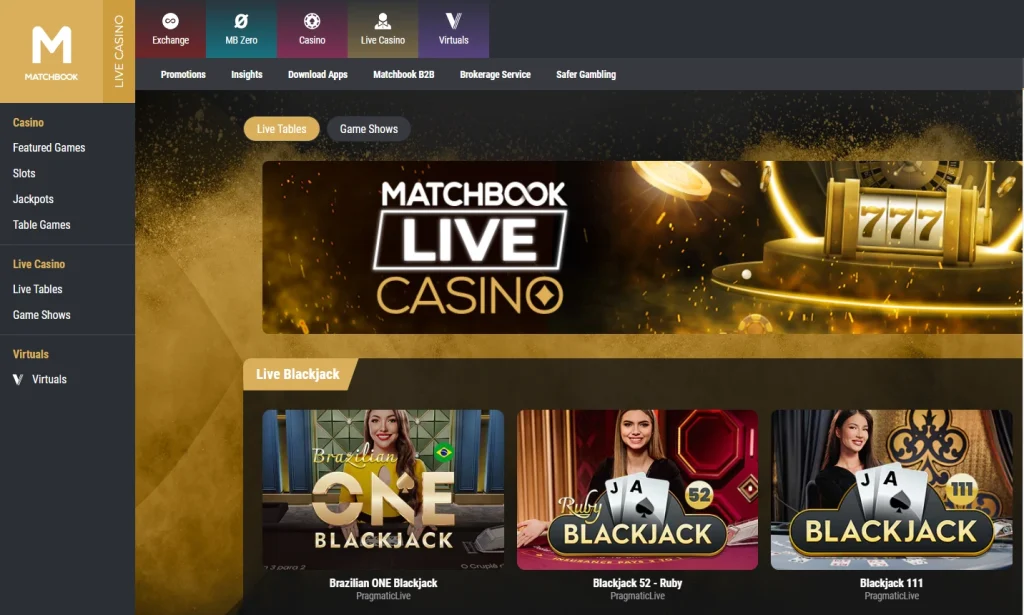
Alongside the exchange, Matchbook runs an online casino on the same account. It covers the usual mix of slots, table games and live dealer tables, so customers can switch from a race to a few spins without opening a second site.
The casino is a side product rather than the main attraction. Its game range is smaller than at casino-first brands. The bigger draw is convenience: one login, one balance and one set of responsible gambling limits across betting and casino. Casino games use the standard house edge built into each title, as at any online casino, so commission rules do not apply here.
App, Payments and Account
Matchbook has apps for iOS and Android, and they are well rated on both stores. The apps carry the full exchange, including back and lay betting, in-play trading, Bet Builder and the casino. They also have a one-tap cash-out feature for exchange positions. For anyone who prefers a browser, Matchbook com loads the same layout on desktop and mobile, with the ladder view and market depth shown next to the odds.
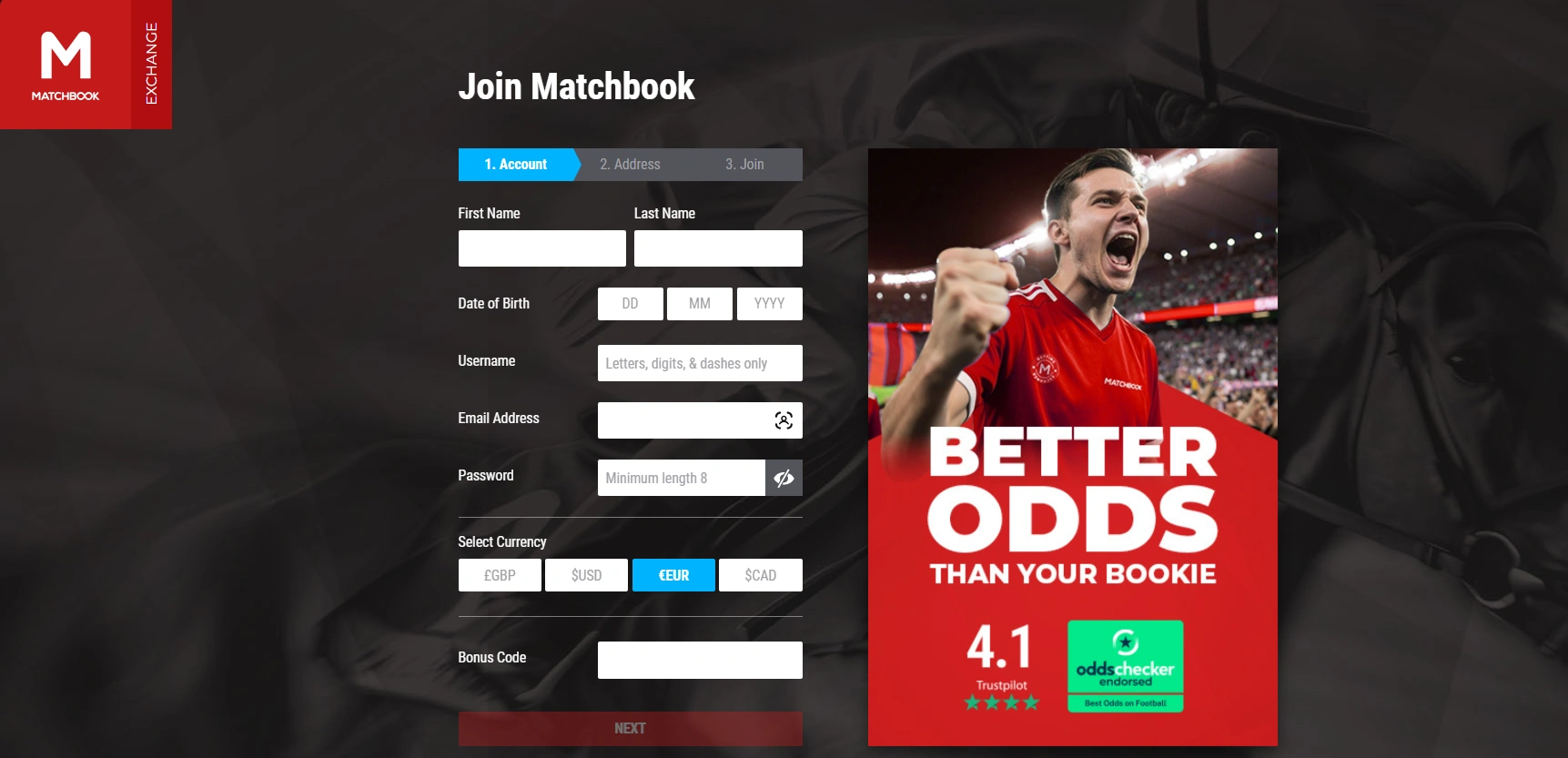
Opening an account follows the standard process for a UK-licensed operator. You give your name, address and date of birth. Matchbook then verifies your age and identity before you can bet, often automatically, and sometimes with a request for a photo ID or proof of address.
The account comes with the usual responsible gambling tools: deposit limits, loss limits, time-outs and self-exclusion. UK customers are also covered by GAMSTOP. The limits apply across the exchange, sportsbook products and casino, so one setting controls the whole account.
Deposits and Withdrawals
Payments are handled in pounds, and the minimum deposit and withdrawal are both £10. The cashier covers the methods most UK punters use, and each one behaves a little differently:
| Method | Deposits | Withdrawals | Worth knowing |
|---|---|---|---|
| Visa and Mastercard debit | Instant | Usually 1 to 3 working days | Credit cards are not accepted under UK rules |
| Apple Pay | Instant | Back to the linked card | Quickest way to fund from a phone |
| Google Pay | Instant | Back to the linked card | Works the same way on Android |
| Skrill and Neteller | Instant | Usually within 24 hours once approved | Often excluded from welcome offers |
PayPal is not available, and neither is cash at retail outlets. Withdrawals follow a closed-loop rule: money goes back to the method you deposited with, up to the amount you paid in, before any other option opens. If you deposited by card and want to cash out to Skrill, you have to clear the card amount first.
Before the first withdrawal, the account has to be fully verified. If the automatic check at sign-up didn’t go through, that means uploading ID and proof of address. Doing it early saves a delay later. The name on the payment method also has to match the name on the account, and Matchbook does not accept third-party cards or wallets. Requests go through a short internal review before they are sent, so a withdrawal made on a Friday evening may only leave on the next working day.
One practical tip: some welcome offers exclude Skrill and Neteller as the first deposit method. If you plan to claim one, use a debit card or Apple Pay for that opening payment.
Pros and Cons
Matchbook AU has clear strengths, but it is not the right fit for every punter. Here is how it stacks up after looking at the whole platform.
Pros:
- low 2% commission on net winnings, charged per market
- Matchbook Zero offers margin-free odds on selected racing and football markets
- deep liquidity on UK racing and major football
- winning punters are not limited the way they often are at bookmakers
- Bet Builder, multiples and a casino on the same account
Cons:
- liquidity thins out on smaller leagues and niche sports
- smaller casino range than casino-first brands
- PayPal is not supported
- the exchange takes some learning for anyone used to fixed odds
Verdict
Matchbook is built for punters who care about price. The 2% commission is charged only on net winnings per market, and the margin-free Matchbook Zero markets go further still. Together they make it one of the more cost-efficient ways to bet on UK racing and top-level football. Over a season of regular betting, the gap between exchange prices and bookmaker odds adds up to real money. An exchange also earns from commission rather than from punters losing, so winning customers aren’t the problem they are for a bookmaker.
The platform is at its best on the big events, where liquidity is deep and bets match almost instantly. It is weaker on smaller leagues and niche sports, where prices thin out and the gap between back and lay odds widens. The extras round it out without changing its character: Bet Builder, multiples, monthly rebates and a compact casino on the same account. Matchbook is still an exchange first.
There is a learning curve. Laying, liability and per-market commission take a little time to understand for anyone coming from fixed odds. Once they click, they give you far more control than a standard bet slip. That control includes trading out of a position before the result is known.
The business itself looks to be heading into a growth phase. The Betdaq deal brings two of the oldest exchanges together into a bigger pool of liquidity. Prediction markets in the UK, with plans for the US, show an operator that has been around for more than twenty years and is still looking for new ground.
What is Matchbook?
Matchbook is a betting exchange where punters bet against each other instead of against a bookmaker. One user backs an outcome, another lays it, and Matchbook earns a commission on net winnings rather than a margin on the odds.
Who owns Matchbook?
Matchbook is operated by Triplebet Ltd, a Guernsey-registered company that has run the exchange since 2011. Its majority owner is Zeljko Ranogajec, the Australian-born professional gambler.
How much commission does Matchbook charge?
The standard rate is 2% of your net winnings on each market. Commission is only charged when you finish a market in profit, and all bets on the same market are netted together first.
What is Matchbook Zero?
Matchbook Zero offers odds with no built-in margin on selected horse racing and football markets, and no commission is charged on winnings. The range of markets is smaller than the full exchange.
What is the difference between backing and laying?
Backing means betting on a selection to win. Laying means betting against it, which puts you in the bookmaker’s position: you win the backer’s stake if the selection loses and pay out the liability if it wins.
Which sports can I bet on at Matchbook?
Horse racing and football have the deepest markets. The exchange also covers tennis, cricket, golf, basketball, American football, rugby, darts, snooker, boxing and MMA.
Does Matchbook have an app?
Yes, Matchbook has apps for iOS and Android with the full exchange, in-play trading, Bet Builder and the casino. The website also works in a mobile browser with the same layout.
What is the minimum deposit at Matchbook?
The minimum deposit and withdrawal are both £10. Accepted methods include Visa and Mastercard debit cards, Apple Pay, Google Pay, Skrill and Neteller, but not PayPal.
Did Matchbook buy Betdaq?
Yes. In October 2026, Matchbook acquired the Betdaq brand and domains, bringing two long-standing exchanges together to build a larger shared pool of liquidity.
Can a betting exchange limit winning punters?
An exchange earns its commission from winning bets, not from punters losing, so it has far less reason to restrict successful customers than a bookmaker does. Accounts are still subject to the usual identity, security and responsible gambling checks.